


Pedals choice
The Complete Guide to Bike Pedals: Flat vs. Clipless vs. Magnetic
US English For decades, choosing bicycle pedals meant a strict compromise: ride flat pedals and risk your feet slipping off when terrain gets rough, or commit to mechanical clipless pedals and accept the steep learning curve, knee strain, and the dreaded zero-speed tip-over.
Today, cyclists have a third distinct choice: magnetic safety pedals.
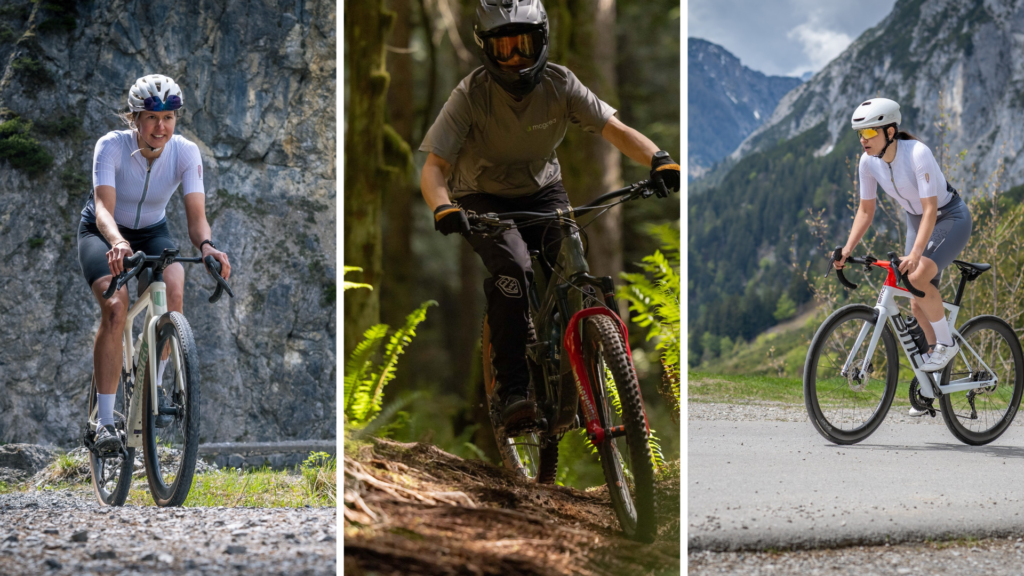
Whether you ride mountain trails, gravel roads, or tarmac, understanding the differences between these three pedal categories will help you choose the right balance of safety, power transfer, and pedaling confidence.
The Three Main Types of Bicycle Pedals Explained
1. Flat (Platform) Pedals
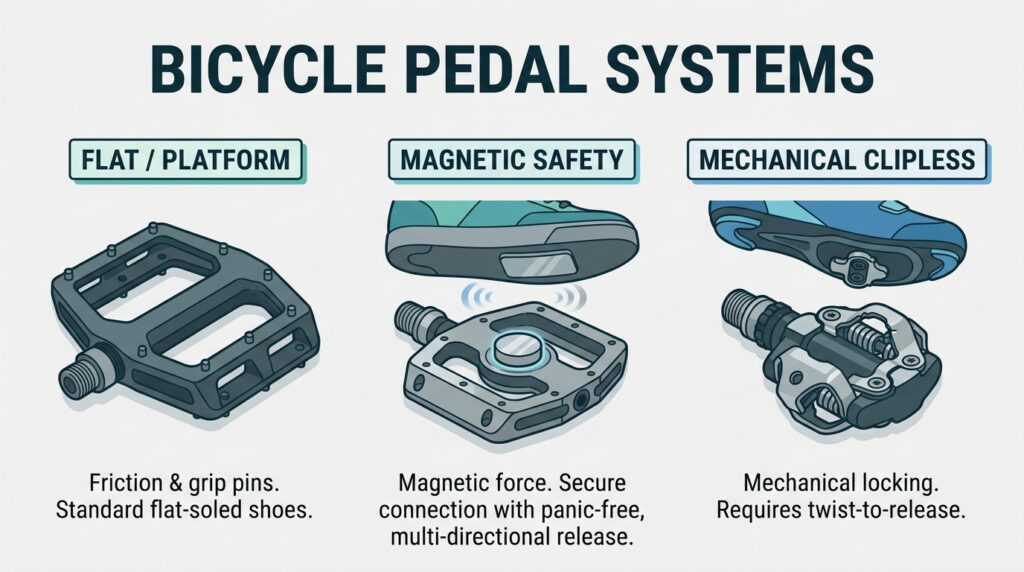
Flat pedals feature a wide platform, often fitted with metal pins or textured rubber, to create friction with the sole of your shoe.
- Mechanism: Pure mechanical friction; no attachment mechanism.
- Best for: Casual riding, dirt jumps, coaching drills, and riders who prioritize stepping on and off instantly without special footwear.
- Drawback: Feet can bounce off in rough sections, and you cannot pull upward through the bottom of the pedal stroke.
2. Mechanical Clipless Pedals
Despite the name “clipless” (a historical term distinguishing them from vintage toe-clips and straps), these pedals physically clamp your shoe to the pedal axle using spring-loaded mechanical jaws.
- Mechanism: Spring-tensioned metal clasp gripping a rigid metal or composite cleat (e.g., SPD, SPD-SL, Look Keo).
- Best for: Competitive road racers and cross-country riders seeking rigid mechanical coupling.
- Drawback: Requires a learned, outward heel twist to release. In sudden emergency stops or panic situations, release can fail, leading to falls. Fixed rotational limits can also trigger joint fatigue and knee discomfort.
3. Magnetic Safety Pedals
Magnetic pedals use high-strength neodymium magnets paired with flat-soled or recessed-cleat cycling shoes to deliver secure foot retention without a rigid mechanical lock.
- Mechanism: Magnetic attraction (typically rated between 100N and 200N of pull strength) acting on a specialized flat steel shoe plate.
- Best for: Beginners, endurance riders, commuters, and technical trail riders who want efficient circular pedaling, continuous joint float, and an intuitive, panic-free release.
- Drawback: Premium upfront cost compared to basic composite platform pedals.
Direct Comparison: Flat vs. Mechanical Clipless vs. Magnetic
|
Feature |
Flat Platform Pedals |
Mechanical Clipless (SPD / Look) |
Magnetic Safety Pedals (Magped Collection) |
|
Retention Method |
Surface friction & traction pins |
Spring-loaded mechanical jaws |
Neodymium magnetic attraction |
|
Release Action |
Lift foot off directly |
Precise outward heel twist |
Natural roll, tilt, or pull in any direction |
|
Beginner Fall Risk |
None |
High (due to panic detent jams) |
Minimal (instant, non-binding release) |
|
Foot Security on Bumps |
Low to Moderate |
High (rigidly locked) |
High (connected via vertical magnetic hold) |
|
Knee & Joint Freedom |
Complete freedom |
Restricted float (usually 4°–6°) |
Continuous natural rotational & lateral float |
|
Uphill Pedaling Efficiency |
Push-only (downstroke) |
Full circular stroke (push & pull) |
Full circular stroke (upward cadence assist) |
|
Shoe Walkability |
Standard flat shoes |
Protruding cleat (Road) / Stiff lug (MTB) |
Flush recessed plate; fully walkable |

Which Pedal System Is Best for Beginners?
When beginners transition from basic recreational cycling to performance riding, pedal anxiety is the number one barrier. Here is how each system impacts early rider confidence:
The Problem with Learning on Mechanical Clipless
Mechanical systems require muscle memory that contradicts natural human instinct. When a beginner loses balance, their reflex is to pull their foot straight up or step outward. In a traditional clipless pedal, an upward pull tightens the mechanical jaw. Releasing requires an intentional, horizontal swivel of the heel. Under adrenaline or panic, beginners frequently freeze, fail to rotate their heel past the disengagement angle, and tip over.
Why Magnetic Pedals Bridge the Gap
Magnetic pedals eliminate the mechanical trap while preserving the performance benefits of foot retention:
- Instinctive Emergency Release: You do not have to twist your heel to get out. If you pull upward with force greater than the magnet rating, or peel your foot sideways, you disengage immediately.
- Elimination of Joint Strain: Clipless cleats force knees into a confined tracking track with limited “float.” Magnetic retention allows the foot to pivot naturally through the pedal cycle, avoiding knee and hip pain.
- Easy “Blind” Step-In: There is no finicky hunting for front cleat hooks or toe-first clicks. Place your foot near the pedal platform, and the magnet guides the plate into alignment.
Discipline-by-Discipline Breakdown
For Mountain Biking (Trail, Enduro & Downhill)
- The Rider’s Pain Point: Fearing high-speed crashes or steep technical stalls where you can’t put a foot down (“dab”) fast enough.
- The Solution: A wide, supportive platform equipped with adjustable perimeter grip pins and central neodymium magnets. You get the stability to hop roots, charge rock gardens, and sprint uphill without being mechanically locked to the bike if you slide out.
- Recommended Models:
- Magped GRAVITY — Built specifically for aggressive downhill, bike park laps, and enduro riders who demand maximum platform area and heavy-duty pin traction.
- Magped ENDURO2 — CNC-machined from aluminum with dual-sided magnets, offering the ultimate balance of retention, rock clearance, and all-mountain durability.
- Magped SPORT2 — A streamlined, versatile platform ideal for cross-country, beginner trail riders, and lighter bikes.
- Read the full guide: The Best Beginner Mountain Bike Pedals: Why Connection Without Being Trapped Matters.
For Gravel & Adventure Cycling
- The Rider’s Pain Point: Harsh vibration fatigue on washboard roads paired with awkward hike-a-bike sections, loose climbs, and mid-ride cafe stops.
- The Solution: Recessed two-bolt SPD-style shoe plates sit flush inside walking-friendly rubber tread. You enjoy continuous foot retention over rough gravel roads, with natural rotational float that protects your knees across 50+ mile days.
- Recommended Models:
- Magped GRAVEL — Ultralight titanium spindle design engineered specifically for gravel racers and fast endurance drop-bar rigs.
- Magped SPORT2 — A fantastic entry-point platform for gravel and adventure touring, offering a wider shoe-sole contact area for extended comfort.
- Magped ULTRA2 — Magnesium body with a titanium spindle for riders who want high strength, low weight, and a premium finish on adventure routes.
- Read the full guide: The Best Beginner Gravel Bike Pedals: Walkability, Comfort, and All-Day Foot Retention.
For Road Cycling & Commuting
- The Rider’s Pain Point: Dread of stopping at red lights, busy urban intersections, and crosswalks with rigid, slippery three-bolt plastic cleats, or feet slipping off wet pedals in city traffic.
- The Solution: Secure magnetic foot connection without looking down or wrenching an ankle to release. You get instant emergency disengagement at traffic lights and complete shoe walkability when popping into offices, shops, or coffee stops.
- Recommended Models:
- Magped ROAD2 — Sleek, aerodynamic design with 3-bolt road shoe compatibility for drop-bar road riders.
- Magped SPORT2 or Magped ULTRA2 — The top choices for urban commuting and city utility riding when paired with casual 2-bolt SPD sneakers, giving you a stable platform that steps in and releases instinctively.
- Read the full guide: The Best Beginner Road Bike Pedals: Eliminating Traffic-Light Panic and Knee Pain.
Frequently Asked Questions
Are magnetic pedals strong enough to pull up on steep climbs?
Yes. Quality magnetic pedals use industrial-grade neodymium magnets producing between 100N (~10 kg / 22 lbs) and 200N (~20 kg / 44 lbs) of linear pull force per pedal. This provides ample retention for round, efficient pedal strokes and steep uphill climbs, while still releasing under high-force emergency movements.
Do magnetic pedals work with standard cycling shoes?
Yes. Magnetic systems like Magped work with standard 2-bolt (SPD / MTB / Gravel) or 3-bolt (Look / SPD-SL / Road) shoe drillings. You simply install a thin, flat steel receiver plate in place of a traditional mechanical cleat. Learn more in our Shoe Compatibility & Setup Guide.
Can mud or dirt prevent magnetic pedals from working?
Unlike mechanical clipless mechanisms, which feature small springs, levers, and recesses that pack with mud, ice, and gravel, magnetic pedals rely on flat contact surfaces. A quick scrape of the shoe sole clears trail debris, and the magnet engages reliably even in wet conditions.
Summary: Upgrade Your Ride with Complete Confidence
You don’t have to choose between slipping off flat pedals or facing the anxiety and rigid lock-in of traditional mechanical clipless systems. By combining continuous circular pedaling efficiency, natural joint-friendly float, and an instinctive, panic-free release, magnetic safety pedals give you the control you want without the fear of falling.
Ready to Find Your Match?
Whether you’re hitting technical singletrack, logging gravel miles, or commuting through city traffic, there’s a magnetic pedal tailored to your riding style.
- Check your shoes: See how easy setup is with your current footwear in our Shoe Compatibility Guide.
- Explore the line: Browse the complete Magped Collection and ride with total peace of mind.